Sunday, March 11, 2012

Jackie O leads the charge to save Grand Central in 1975


This is one of my favorite pictures of Jacqueline Onassis from 1975, the year when Aristotle Onassis died, she becomes engaged in the battle to save Grand Central from redevelopment ruin and she becomes a book editor. Essentially, 1975 is the year that Jackie has a midlife crisis -- she loses a husband, saves a landmark and finds herself.

The picture above is from a dramatic press conference held in the train terminal's famed Oyster Bar (see below for a picture I took recently -- still looks like 1975 inside!). I love the expression on her face, which reflects her serenity, power, and knowledge that she is the center of attention, sitting before a media horde from around the world, assembled in the subterranean restaurant to hear her big voice that sounded little.

Jackie proved herself to be a public relations mastermind when it came to repelling real estate developers' dreams of altering the built environment of New York City.


Grand Central was her first real victory. 

“If we don’t care about our past we can’t have very much hope for our future,” she said into a bank of microphones and over the din of flashbulbs popping. “We’ve all heard that it’s too late, or that it has to happen, that it’s inevitable. But I don’t think that’s true. Because I think if there is a great effort, even if it’s the eleventh hour, then you can succeed and I know that’s what we’ll do.”

Her words, which she had written herself, were spare. She knew from her political experiences that if she delivered a forty-five-minute speech it would lose its effectiveness and she would have a greater chance of being misquoted. Deliver a sound bite just right and the press had to use it. They had nothing else.


Friday, February 17, 2012

White House Restoration Redux

I've wondered for some time what happened to the White House interior after Jacqueline Kennedy so meticulously restored it with period-appropriate antiques, colors and grandeur.  Did the Johnsons keep it as an untouchable mausoleum? Did Nancy Reagan paint it red?

I've got some answers.

On the 50th anniversary of Jackie's televised tour of her work at 1600 Pennsylvania Avenue, current White House Curator William Allman explained this week that the place continues to evolve and has, in fact, changed quite a bit since the Kennedy era.

Here's how:

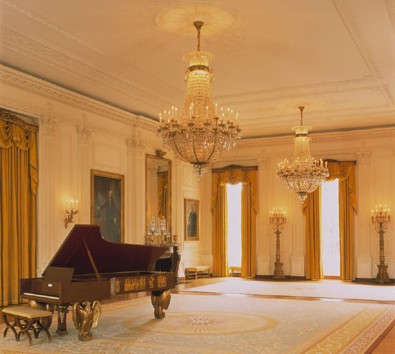
The East Room, where the Kennedys held that famous dinner for Nobel Prize winners, now has a rug, thanks to Barbara Bush, as well as restored red marble mantels, which Jackie had painted white. Here it is in her time.

This is it with the Bush rug...with the photo taken in the Clinton era.

The Blue Room has also seen many iterations. Here it was in 1963.


And here it is in 1972, with different paper and draperies.

The Nixons significantly changed the Green Room, moving out Jackie's Federal Period furniture and replacing it with Duncan Phyfe pieces.

The room went from this:

To this:

Laura Bush later added a jarring modernist painting by Jacob Lawrence to the room called "The Builders."


You can see it in context in this portrait of the Obama family. To the left of the President, out of sight, hangs a John Singer Sargent painting called "Mosquito Net."

There is one room, however, that I think has been improved since Jackie last touched it: the Lincoln Bedroom. Jackie's version felt simple (as simple as a Victorian-furnished room could feel). But after seeing what Laura Bush did to it, the Camelot version seems unfinished. Fitting, perhaps.


Monday, February 13, 2012

How Jackie's personal papers humanize an icon

I spent my morning at the JFK Library poring over newly released personal papers that belonged to Jacqueline Kennedy during her White House years. Much of the documentation relates to her restoration of the White House. See my blog post below.

But I always enjoy finding the little gems that humanize an icon: her memos about choosing what would become her trademark blue stationery from Tiffany; how she was concerned about the White House nursery school's car pool schedule (what if a child didn't have a ride!); the typed up plan for John Jr.'s play dates (Tuesdays at Jonathan's in Chevy Chase); and even her Christmas shopping list, which included Van Cleef & Arpels, where her engagement ring was from, Maximillian Fur Co., Givenchy, Bergdorf Goodman, Chanel, Norman Norell, and Design Research, the little shop in Harvard Square owned by Ben and Jane Thompson.

Readers of this blog might recall that last summer we stayed at the Thompson summer house in Barnstable, just across Route 6 from the Kennedy compound in Hyannis Port. Later, we heard that Jackie used to go to the house -- apparently she was a fan of Marrimekko, which the Thompsons sold at DR. Today, I stumbled on the proof in her Christmas list, which listed the house's address.


I can picture Jackie pulling into the gravel driveway wearing her Renauld of France sunglasses and a scarf on her head. Makes me nostalgic for the Cape in the summer.

JFK Library Releases Jacqueline Kennedy's personal papers

Today, the JFK Library released papers not yet seen publicly that show how seriously Jacqueline Kennedy approached her White House restoration project. 

Yes, she sketched the draperies (above) and chose the colors -- but went far beyond that. The papers, released 50 years after she gave a televised tour of the nearly completed work, show that she was studious and intense about the project, scouring old receipts and photographs to find objects, their origins, and where they belonged in the White House, including four Cézanne paintings hanging in the National Gallery of Art that were moved to the family quarters. 


She consulted historians and made basement spelunking expeditions with Lorraine Pearce, whom she hired to be the White House’s first curator. They found Teddy Roosevelt’s rugs, Monroe’s gold and silver French flatware and a heavy oak desk, piled with electronics in the broadcast room, that Queen Victoria had given to President Hayes. Jackie had it set up in the Oval office. John Jr. would later crawl beneath it. 


The restoration took about two years, but on Feb. 14, 1962, she wore a red Rodier boucle suit and took America on a one-hour televised tour of the mansion, a Valentine for 80 million viewers, few of whom knew she was also strategizing to save Lafayette Square -- a grassy quadrangle surrounded by 18th century town homes in front of the White House -- at risk of being replaced by modernist office space for the government (a plan Eisenhower had set in motion).


Later, in 1975, she catalyzed New York City to save Grand Central Terminal from being obliterated for a bland skyscraper, a case that went to the US Supreme Court and made historic preservation mainstream in the process.


Half a century later, on the golden anniversary of her televised White House tour, newly released memos confirmed that she was the politically and historically astute ring leader of the restoration. In the midst of other “news” last week about JFK’s affair with a White House intern, we’re still watching Jackie, hopefully more enthralled with her accomplishments – then and later in her life -- than her husband’s conquests.


Saturday, January 21, 2012

A new documentary about Ethel Kennedy


This must be the year for the Kennedy women to shine. I’m all for it.

With the release earlier this fall of Jacqueline Kennedy’s taped oral history completed shortly after the assassination of her husband, and her daughter, Caroline, publishing the book to accompany those tapes, we now have “Ethel,” the documentary that premiered at the Sundance Film Festival this week, with Taylor Swift as lead groupie. (As JFK said in his inaugural address, "Let the word go forth...that the torch has been passed to a new generation of Americans.") Ethel Kennedy’s daughter Rory created the film as a “love letter” to her 83-year-old mother, whose last interview, according to Boston Globe film critic Ty Burr, was 30 years ago.

(Rory and Ethel Kennedy with Taylor Swift at the Sundance premier of "Ethel." Above, Ethel is seated at the back of the porch.)

I met Ethel once, in her home in Hyannis Port, at a clam bake on the famous compound lawn hosted by her son, then-US Rep. Joseph P. Kennedy II, whose 31-year-old son, Joe III, appears to be running for Congress. I was covering politics at the time. Before I left the annual event, I needed to use the loo. Which meant going into Ethel’s house, where she was milling around the kitchen. I was struck by how preppy the space was decorated, all Kelly green upholstery and white piping. It was chipper, the way she presented herself to the world, which always struck me as amazing given the tragedies she had gone through. She graciously directed me through the house.

It’s not clear when the film will debut on HBO this year. But I won’t miss it.

Linda Rodin's Third Act

She's 63 and and yet, would she not be the first person your eyes landed on in a busy room?


My Saturday morning ritual begins withe the Wall Street Journal and cup of coffee. And today, moments into this routine, I was delighted to read a piece on Linda Rodin (pictured), a stylist who has worked for Madonna and does the Victoria's Secret fashion shoots.

Rodin hasn't worn makeup since she was 30, except for matte lipstick. She drinks green juice, wears sunscreen in the summer (20 spf) and is rail-thin despite never working out. She snacks on seaweed, has never colored her hair and gets a weekly blowout.

"The secret to aging gracefully is maintenance," she said. "Botox is fine in moderation, but the more you do the older you look. You can't chase youth. You'll just look old with a facelift."

But the most interesting thing about her is that she launched a beauty product business called Rodin Olio Lusso in 2008, at a time when many are staring at retirement.

Wednesday, November 23, 2011

Thanksgiving traditions


Last Thanksgiving, I was excited to cook my first turkey in our new house. Deciding whether the time had come to use my grandmother’s china,what side dishes to prepare (sweet potatoes vs. carrots or both), which tablecloth, what time guests should arrive – all of these things had the potential to become part of a new tradition.

I was especially conscious that morning of how traditions are formed and sustained, knowing this Victorian kitchen, with its enormous vintage Vulcan range that came with the sale, clearly had been the heart of the home for the previous owners and their big family for more than half a century.

I wondered what they ate, if they fired all six burners and both ovens, who sat where, and how many people typically came.

As I was running around in my apron and hoping that the oven still had an accurate temperature reading, the doorbell rang at the back of the house. We weren't expecting anyone – yet. It was about 10 a.m. And we rarely used that entrance.

We opened the door to find a stranger in a baseball cap. He seemed to be in his mid-60s. He was holding a bottle of Greek liquor – Metaxa – and seemed as surprised to see us as we were to see him.

He also seemed a little sad, and a little embarrassed.

The man said he suspected that the home’s previous matriarch, who was in her 90s, had died recently, triggering the sale of the house. But he had to come one last time – just to make sure that all of his high school buddies weren’t gathering in the basement after the Brookline-Newton North football game (itself a century-old tradition) as they had done every year since they were teenagers. And perhaps as our boys will someday do).

We knew his story was true -- our neighbors had told us about this huge annual event that filled the backyard and the cellar for the last 50 years, explaining why our basement had been outfitted as a man cave  with a bar, mounted television and a pool table.

Please come in, we said.

He was the grog maker of the group and sheepishly held up his bottle toward the steaming stove top. We half jokingly told him to feel free to make the brew. He laughed.

We offered to give him a tour beyond the kitchen. He made it as far as the dining room, where the table was already set, and then he demurred to see more, knowing that the house had changed enough.
But we wouldn’t let him leave. We had questions.

Tell us about your friends -- the four brothers who grew up here. What had become of them? He told us what they did, where they lived, what they were like.

We imagined them, once upon a time, bounding up and down the stairs, as our three sons do now.

The stranger told us about the patriarch, a restaurateur who had died years before, whose name is still painted on the window of the greenhouse.

The mother, he said, had worked at her son’s sneaker company later in life. And, he said as his eyes saw a past that we could not, they all loved the post-Thanksgiving game tradition.

He warmly obliged us for about 15 minutes before saying he should go; he had some friends to call and a long drive home ahead of him.

As he went out the back, we said goodbye, and closed the door behind him, feeling a rush of cold air.

Walking back to the stove, I appreciated it a little more, and wondered if our new traditions would last as long as the grog maker’s.

This Thanksgiving, I don’t expect the backdoor bell to ring again, but would be happy if it did.